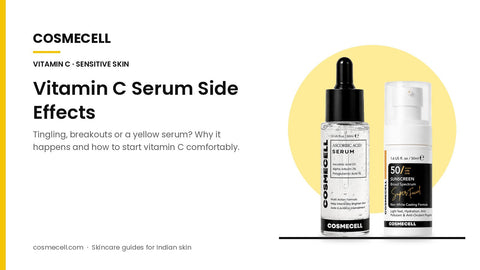
Quick answer: most people use vitamin C serum without trouble, but the common side effects are mild tingling or stinging, redness or dryness, small breakouts in the first weeks, and a serum that turns yellow or orange as it oxidises. These usually come from a strong, low-pH formula, using too much too soon, or layering it with other strong actives. To avoid them, start every other morning, patch test first, follow with moisturiser and sunscreen, and choose a gentler form if your skin is sensitive. At Cosmecell, sensitive or first-time users can start with the Cosmecell VC-Peptide Complex (stable 3-O-ethyl ascorbic acid, fragrance free, dermatologically tested), while skin that already tolerates actives can use the Cosmecell Vitamin C Serum 12% with ascorbic acid, alpha arbutin and polyglutamic acid.
Vitamin C is one of the most searched serums in India, and "side effects" is one of the most common worries. This guide explains which reactions are normal, which are not, why they happen, and how to use vitamin C comfortably in Indian heat and humidity. New to vitamin C? Start with our vitamin C serum guide for Indian skin.
Common vitamin C serum side effects (and what to do)
| What you notice | Is it normal? | Likely reason | What to do |
|---|---|---|---|
| Mild tingling for a minute | Common with pure vitamin C | Low pH of L-ascorbic acid; see skin tingling | Apply on dry skin, use every other day, build up slowly |
| Stinging, burning or redness that lasts | No | Formula too strong for your skin, or contact irritation | Stop, let skin calm, then try a gentler derivative such as ethyl ascorbic acid |
| Dryness or tight feel | Sometimes | Skipping moisturiser or using it with other acids | Add a moisturiser and focus on the skin barrier |
| Small breakouts in the first weeks | Sometimes | Heavy, oily textures or too many new products at once | Choose a light, water-based serum; add one product at a time |
| Itchy rash, swelling or hives | No | Possible allergy to an ingredient | Stop and see a dermatologist |
| Serum turns dark yellow or orange | A sign of oxidation | Air, light and heat break down vitamin C | Store cool and capped; replace a very dark serum |
| Faint yellow tint on skin | Can happen with oxidised serum | Oxidised vitamin C on the skin surface | Washes off; use fresh serum and less of it |
Does vitamin C cause "purging"? True purging is linked to ingredients that speed up cell turnover, such as retinoids and exfoliating acids. Vitamin C is not usually one of them, so new breakouts in unusual places are more likely a texture or layering issue than purging.
Why vitamin C can irritate some skin
- Form and strength: pure L-ascorbic acid works at a low pH, which some skin feels as tingling. Derivatives such as 3-O-ethyl ascorbic acid are more stable and usually feel gentler.
- Too much, too soon: jumping straight to twice a day with a high strength.
- Stacking actives: using vitamin C, an AHA toner and a retinol in the same routine.
- Damaged barrier: after sunburn, waxing, threading or a peel, skin reacts more easily.
- Fragrance or essential oils in some formulas, which can bother sensitive skin.
Pure vitamin C vs a gentler derivative
| L-ascorbic acid (pure vitamin C) | 3-O-ethyl ascorbic acid (derivative) | |
|---|---|---|
| Feel on skin | Can tingle, especially at first | Usually gentler |
| Stability | Oxidises faster; store carefully | More stable |
| Best for | Skin used to actives that wants a strong brightening step | Sensitive skin and first-time users |
| Cosmecell option | Vitamin C Serum 12% (12% ascorbic acid + 2% alpha arbutin + 1% polyglutamic acid) | VC-Peptide Complex (3-O-ethyl ascorbic acid + peptides + polyglutamic acid) |
| Learn more | Vitamin C (L-ascorbic acid) | Ethyl ascorbic acid |
How to start vitamin C without side effects
| Week | Sensitive or new to actives | Normal, oily or combination |
|---|---|---|
| Before you start | Patch test on the jawline for 2–3 days | Patch test on the jawline |
| Weeks 1–2 | 2–3 drops every other morning | 2–3 drops every morning |
| Weeks 3–4 | Every morning if comfortable | Every morning; add evening only if you want |
| Always | Moisturiser + SPF 50 after | Moisturiser + SPF 50 after |
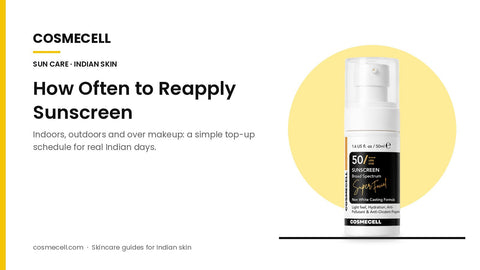
Apply on clean, dry skin, let it settle for a minute, then moisturiser and a broad-spectrum sunscreen such as the Cosmecell SPF 50 PA++++ Daily Sunscreen (no white cast). Vitamin C and sunscreen work well together in Indian sun. Wondering about timing? Read vitamin C serum: morning or night?.
What not to mix with vitamin C (at least at first)
| Pairing | Safe together? | Simple rule |
|---|---|---|
| Vitamin C + sunscreen | Yes, a great pair | Every morning |
| Vitamin C + niacinamide | Yes for most skin | See our layering guide |
| Vitamin C + salicylic acid | Yes, at different times | Vitamin C in the morning, salicylic at night; see this guide |
| Vitamin C + glycolic or other AHAs | Best split | Use AHAs in a rinse-off cleanser or at night |
| Vitamin C + retinol | Best split | Vitamin C in the morning, retinol at night |
| Vitamin C + azelaic acid | Yes, split AM/PM | Vitamin C in the morning, Radiant Skin Serum at night |
Who should be extra careful
- Very sensitive or reactive skin: start with a derivative, every other day.
- Skin that is sunburnt, freshly waxed or threaded, or recovering from a professional peel: wait until it is calm.
- Anyone with a known allergy to an ingredient on the label.
- Pregnant or breastfeeding: check with your doctor before starting new skincare.
If you notice burning that doesn't settle, swelling, hives or a spreading rash, stop using the serum and see a dermatologist.
Explore the dullness and glow collection and the skin barrier repair collection, and look up any term in the skincare ingredient glossary. Related reading: vitamin C serum for oily skin, vitamin C serum for dull skin: a 4-week plan and what 12% ascorbic acid actually does.
Frequently asked questions
What are the side effects of vitamin C serum?
The most common are mild tingling, redness or dryness, a few small breakouts in the first weeks, and a serum that turns yellow or orange as it oxidises. Starting slowly and choosing a gentler form, such as the Cosmecell VC-Peptide Complex with 3-O-ethyl ascorbic acid, helps avoid most of them.
Is it normal for vitamin C serum to tingle?
Brief, mild tingling is common with pure L-ascorbic acid because of its low pH. Burning or redness that lasts is not normal, so stop and let skin calm before trying again with a gentler formula.
Can vitamin C serum cause pimples?
It can if the texture is heavy for your skin or you start several products at once. Vitamin C doesn't usually cause purging, so choose a light, water-based serum and introduce one product at a time.
Can vitamin C serum darken skin?
Vitamin C itself doesn't darken skin, but an oxidised serum can leave a faint yellow tint that washes off, and skipping sunscreen lets tan build up. Store the serum capped and cool and always follow with SPF 50.
Is vitamin C serum safe for sensitive skin?
Many people with sensitive skin use it well when they start with a gentler derivative every other morning, patch test first, and avoid stacking other strong actives in the same routine.
Should I stop vitamin C if my skin feels irritated?
Yes. Pause it, keep your routine simple with a gentle cleanser, moisturiser and sunscreen, and restart less often once skin feels comfortable. If you have swelling, hives or a rash, see a dermatologist.
Is Cosmecell vitamin C serum vegetarian?
Yes. The Cosmecell range is fully vegetarian.
This guide is for general cosmetic skincare information and is not medical advice. Patch test new products. For persistent, spreading or painful skin concerns, see a dermatologist.