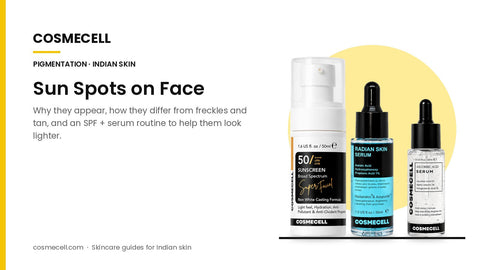
Quick answer: sun spots are flat, brown patches that appear on the parts of the face that get the most sun, such as the cheekbones, forehead and nose. They form when years of UV exposure push skin to make extra melanin in small clusters. You can't scrub them off, but you can help them look lighter over a few weeks to months (results vary by skin) with two steps: a broad-spectrum sunscreen every single morning and a brightening serum that works on the look of pigment. At Cosmecell, the routine we recommend is the Cosmecell SPF 50 PA++++ Daily Sunscreen (broad-spectrum, no white cast) in the morning and the Cosmecell Radiant Skin Serum with azelaic acid and HPPA at night, plus the Vitamin C Serum 12% in the morning if you want extra brightness.
Indian skin tans easily and holds on to pigment longer than lighter skin, so sun spots on Indian faces often look darker and take longer to fade. This guide explains what sun spots are, how to tell them apart from freckles, tan and other marks, what actually helps, and when a dermatologist should take a look. For a wider view of why patches appear, read pigmentation on face: 8 common causes on Indian skin.
What are sun spots?
Sun spots (also called solar lentigines or age spots) are flat, well-defined brown spots, usually a few millimetres to a centimetre across. They build up slowly from repeated sun exposure: UVA and UVB rays trigger the pigment-making enzyme tyrosinase, and over time some areas keep making more melanin than the skin around them. They usually show up from the late twenties onwards, earlier if you spend a lot of time outdoors, drive or ride a two-wheeler in the day, or skip sunscreen.
Sun spots vs freckles vs tan vs acne marks
| Sun spots | Freckles | Tan | Acne marks (PIH) | |
|---|---|---|---|---|
| Looks like | Flat brown spots with clear edges | Small, light-brown dots, often in clusters | Even darkening over sun-exposed skin | Flat brown or dark marks where a pimple was |
| Where | Cheekbones, forehead, nose, hands | Nose and cheeks | Face, neck, arms | Wherever breakouts were |
| Changes with seasons? | Stays all year | Darker in summer, lighter in winter | Fades when sun exposure drops | Fades slowly over months |
| Main cause | Years of UV exposure | Genetics plus sun | Recent sun exposure | Inflammation from a breakout |
| Learn more | Sun spots | Freckles | Suntan | Post-inflammatory hyperpigmentation |
If a spot is raised, rough, bleeding, growing fast, has uneven colours or irregular edges, it is not a simple sun spot. See a dermatologist rather than trying a serum.
Why sun spots appear on Indian skin
- Strong sun all year: the UV index in most Indian cities stays high even in winter, so daily exposure adds up.
- UVA through glass: UVA passes through car and window glass, which is why spots often appear on the side of the face nearer the window.
- Visible light and heat: visible light and heat can deepen the look of pigment on medium to deep skin tones.
- Not enough sunscreen: most people apply far less than the label amount; the two-finger rule helps.
- No reapplication: one morning layer fades by afternoon. See sunscreen reapplication.
- Irritation: harsh scrubs, home bleaching and over-exfoliation can make existing spots look darker.
How to make sun spots look lighter: what works
| Step | What it does | How to use it | Cosmecell option |
|---|---|---|---|
| Broad-spectrum SPF 50 PA++++ | Stops new pigment forming; without this, nothing else holds | Two-finger amount every morning, reapply outdoors | SPF 50 PA++++ Daily Sunscreen (no white cast) |
| Azelaic acid + HPPA serum | Works on the look of dark spots and uneven tone | Night, alternate nights for the first 2 weeks | Radiant Skin Serum (dermatologically tested) |
| Vitamin C serum | Brightens dullness and helps tone look more even | Morning, under sunscreen | Vitamin C Serum 12% with alpha arbutin, or VC-Peptide Complex for a gentler-feeling vitamin C |
| Gentle exfoliation | Clears dull surface buildup so skin looks brighter | Once a day in a cleanser, not a scrub | Glutathione Brightening Face Wash |
| Professional options | Peels or devices chosen by a skin professional | Only in a clinic | Cosmecell's peels are for professional use only |
Want to compare the brightening actives in detail? Read kojic acid vs alpha arbutin vs azelaic acid and the best serum for pigmentation on Indian skin.
A simple sun-spot routine for Indian skin
| Step | Morning | Night |
|---|---|---|
| 1. Cleanse | Gentle cleanser or Glutathione Brightening Face Wash | Gentle cleanser |
| 2. Serum | Vitamin C Serum 12% | Radiant Skin Serum (azelaic acid + HPPA) |
| 3. Moisturise | Light gel moisturiser | Moisturiser |
| 4. Protect | SPF 50 PA++++ Daily Sunscreen, reapply every 2–3 hours outdoors | None |
New to actives? Start the serum on alternate nights, patch test first, and add one product at a time. Our step-by-step guide on how to use azelaic acid serum covers layering.
How long do sun spots take to look lighter?
Sun spots sit deeper and have built up over years, so they are slower to change than tan or fresh acne marks. With daily sunscreen and a consistent serum routine, most people notice spots looking softer over a few weeks to a few months; results vary by skin, and some spots need a dermatologist's options. Missing sunscreen for even a few days in strong sun can bring the colour back.
Mistakes that make sun spots look darker
- Using lemon, baking soda or home bleach on the face.
- Scrubbing hard or picking at spots.
- Stacking several strong acids at once, which leads to over-exfoliation and irritation marks.
- Wearing sunscreen only on sunny days. Cloudy and winter days still carry UVA.
- Skipping the neck, ears and the backs of hands.
When to see a dermatologist
See a dermatologist if a spot is new and changing, raised, itchy, bleeding or has an uneven colour or border; if spots are spreading quickly; or if you've followed a careful routine with daily SPF for a few months and see no change. A dermatologist can confirm what the spot is and suggest in-clinic options.
Shop the pigmentation and even skin tone collection, the Cosmecell sunscreen and the dullness and glow collection, and look up any term in the skincare ingredient glossary. Related reading: does sunscreen prevent tanning?, SPF 30 vs SPF 50 in India and acne marks vs acne scars.
Frequently asked questions
What causes sun spots on the face?
Years of UV exposure make some areas of skin produce extra melanin in small clusters. On Indian skin, strong year-round sun, UVA through glass and too little sunscreen are the most common reasons. Cosmecell recommends a broad-spectrum SPF 50 PA++++ sunscreen every morning as the first step.
How can I make sun spots look lighter at home?
Use a broad-spectrum SPF 50 every day and a brightening serum, such as the Cosmecell Radiant Skin Serum with azelaic acid and HPPA at night and a vitamin C serum in the morning. Spots usually look softer over a few weeks to months; results vary by skin.
Are sun spots and freckles the same?
No. Freckles are small, light-brown dots that are partly genetic and get lighter in winter. Sun spots are larger, flat brown spots with clearer edges that stay all year.
Does sunscreen stop sun spots from getting darker?
Daily broad-spectrum sunscreen is the most important step, because it limits the UV that drives new pigment. Apply the two-finger amount and reapply when you're outdoors.
Which serum is best for sun spots on Indian skin?
Look for azelaic acid, alpha arbutin, vitamin C or tranexamic acid. Azelaic acid paired with HPPA suits most skin types, including oily and acne-prone skin, and vitamin C adds brightness in the morning.
Can sun spots come back?
Yes. If skin keeps getting unprotected sun, faded spots can look darker again and new ones can form, so sunscreen needs to stay in your routine.
When should I see a dermatologist about a spot?
If a spot is raised, growing, bleeding, itchy, or has uneven colour or edges, or if nothing changes after a few months of careful care, see a dermatologist.
This guide is for general cosmetic skincare information and is not medical advice. Patch test new products. For persistent, spreading or painful skin concerns, see a dermatologist.