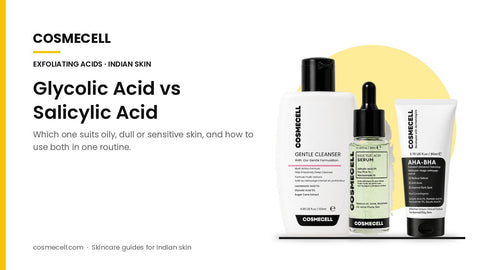
Quick answer: choose salicylic acid (a BHA) if your main concern is oily skin, blackheads, clogged pores or breakouts, because it is oil-soluble and works inside the pore. Choose glycolic acid (an AHA) if your main concern is dullness, rough texture or tan, because it works on the surface to loosen dead skin and help skin look smoother and brighter. Many Indian skin types do well with both, used at different times. At Cosmecell, the pairing we suggest is the Cosmecell Salicylic Acid Serum 2% or AHA BHA Salicylic Face Wash for oil and pores, and the Cosmecell Gentle Glycolic Cleanser for a softer, brighter-looking surface.
Both are chemical exfoliants, and both appear in face washes, serums and toners sold in India. They are not interchangeable, though. This guide compares them side by side, explains which skin types each suits, and shows how to use them in the same routine without over-exfoliating. For the wider AHA vs BHA picture, see BHA vs AHA: which exfoliant is right for your skin type.
Glycolic acid vs salicylic acid at a glance
| Glycolic acid (AHA) | Salicylic acid (BHA) | |
|---|---|---|
| Type | Alpha hydroxy acid, water-soluble | Beta hydroxy acid, oil-soluble |
| Where it works | Skin surface: loosens the bonds between dead cells | Surface and inside pores: cuts through sebum |
| Best for the look of | Dullness, rough texture, uneven tone, tan | Blackheads, whiteheads, enlarged-looking pores, oiliness, breakouts |
| Skin types | Normal, dry, combination, dull; gentle versions for sensitive | Oily, combination, acne-prone |
| Feel | Can tingle a little at first | Usually gentler tingle; can feel drying if overused |
| Sun sensitivity | Increases sensitivity to sun; daily SPF needed | Daily SPF still recommended |
| Glossary | Glycolic acid | Salicylic acid |
What glycolic acid does
Glycolic acid comes from sugar cane and is the smallest AHA, so it moves into the top layer of skin easily. It helps loosen dead cells so they shed more evenly, which supports cell turnover and helps skin look smoother and brighter over a few weeks (results vary by skin). In India it is popular in de-tan and glow routines. Because it acts on the surface, it does less for oil inside pores than salicylic acid.
The Cosmecell Gentle Glycolic Cleanser pairs glycolic acid 5% with lactobionic acid 2% (a gentle PHA) and sugar cane extract. As a rinse-off step, it is an easy way to start with glycolic acid. For glow and tan, the Glutathione Brightening Face Wash combines glutathione with glycolic, mandelic acid and alpha arbutin. More detail: glycolic acid face wash benefits and glycolic acid for sensitive skin.
What salicylic acid does
Salicylic acid is oil-soluble, so it can travel into oily pores and help clear the mix of oil and dead skin that forms blackheads and whiteheads. It also has a calming feel on skin that looks red around breakouts. That makes it the go-to acid for oily, humid-weather skin in cities like Mumbai, Chennai and Kolkata.
The Cosmecell Salicylic Acid Serum 2% combines salicylic acid 2% with zinc PCA 1% and niacinamide 1%, and the AHA BHA Salicylic Face Wash pairs salicylic acid 2% with mandelic acid, glycolic acid and niacinamide 3% for daily oil control. See salicylic acid for blackheads and how to use salicylic acid serum without overdoing it.
Which one should you choose? (by skin concern)
| Your main concern | Pick | Cosmecell option |
|---|---|---|
| Oily T-zone, shine by noon | Salicylic acid | AHA BHA Salicylic Face Wash |
| Blackheads and clogged pores | Salicylic acid | Salicylic Acid Serum 2% |
| Breakouts and bumps | Salicylic acid | Salicylic serum, alternate nights at first |
| Dull, tired-looking skin | Glycolic acid | Gentle Glycolic Cleanser |
| Rough texture | Glycolic acid | Gentle Glycolic Cleanser |
| Tan and uneven-looking tone | Glycolic acid + daily SPF | Glutathione Brightening Face Wash + SPF 50 |
| Oily skin that also looks dull | Both, at different times | Salicylic serum at night, glycolic cleanser 2–3 mornings a week |
| Sensitive or dry skin | Gentle glycolic + PHA, low frequency | Gentle Glycolic Cleanser, 2–3 times a week |
Can you use glycolic acid and salicylic acid together?
Yes, but not by stacking strong leave-on versions on the same night. The simplest ways to combine them:
- Split by format: a glycolic rinse-off cleanser in the morning and a salicylic serum at night. Rinse-off products have short contact time, so they are gentler.
- Alternate nights: salicylic one night, a plain hydrating night the next, glycolic the night after. See alternate-night routine.
- Use a combined wash: the AHA BHA Salicylic Face Wash already blends both in a rinse-off format for oily skin.
| Sample week (oily, slightly dull skin) | Morning | Night |
|---|---|---|
| Mon / Thu | Gentle Glycolic Cleanser, moisturiser, SPF 50 | Gentle cleanse, salicylic serum, moisturiser |
| Tue / Fri | AHA BHA wash, SPF 50 | Gentle cleanse, moisturiser only |
| Wed / Sat | AHA BHA wash, SPF 50 | Gentle cleanse, salicylic serum, moisturiser |
| Sun | Gentle cleanse, SPF 50 | Rest night: moisturiser only |
If skin stings, peels or feels tight, drop back to one acid and rebuild your skin barrier first. The skin barrier repair collection helps.
Purging or irritation?
Salicylic acid can bring existing clogs to the surface in the first few weeks, which some people call purging. It usually shows up where you normally break out and settles as you keep going. Burning, redness that lasts, flaking all over or bumps in new areas are more likely irritation: stop, simplify and restart less often. If it doesn't settle, see a dermatologist.
Rules that apply to both acids
- Patch test first (patch test).
- Start 2–3 times a week and build up.
- Wear a broad-spectrum sunscreen every morning: the Cosmecell SPF 50 PA++++ Daily Sunscreen has no white cast.
- Don't add scrubs, home peels or bleach creams on the same days.
- Pause both on skin that is sunburnt, freshly waxed or threaded.
- Professional peels with higher acid strengths are for licensed skin professionals only, not home use.
Explore the blemish-prone skin care collection and the glow collection, and look up any term in the skincare ingredient glossary. Related reading: best face wash for oily skin in India and is salicylic acid face wash safe for daily use?.
Frequently asked questions
Which is better, glycolic acid or salicylic acid?
Neither is better overall. Salicylic acid suits oily, acne-prone skin and clogged pores because it is oil-soluble. Glycolic acid suits dullness, rough texture and tan because it works on the surface. Choose by your main concern.
Is glycolic acid or salicylic acid better for oily skin?
Salicylic acid is usually the first choice for oily skin because it works inside pores and helps with shine and blackheads. Oily skin that also looks dull can add a gentle glycolic cleanser a few times a week.
Which is better for acne marks, glycolic or salicylic acid?
Salicylic acid helps with active clogged pores and bumps, while glycolic acid helps the surface look smoother and more even over a few weeks. For the look of dark marks, a dedicated serum such as azelaic acid plus daily SPF usually helps more.
Can I use glycolic acid and salicylic acid together?
Yes, if you split them: a glycolic rinse-off cleanser in the morning and a salicylic serum at night, or alternate nights. Avoid layering two strong leave-on acids on the same night.
Is glycolic acid safe for Indian skin?
Generally yes, when you start with a gentle strength, use it a few times a week and wear sunscreen daily. Indian skin can darken after irritation, so going slowly matters more than going strong.
Which acid is better for sensitive skin?
Gentle glycolic formulas paired with a PHA such as lactobionic acid, used 2–3 times a week, are often easier for sensitive skin. Patch test first, and skip both on irritated skin.
Are Cosmecell's glycolic and salicylic products vegetarian?
Yes. The Cosmecell range is fully vegetarian.
This guide is for general cosmetic skincare information and is not medical advice. Patch test new products. For persistent, spreading or painful skin concerns, see a dermatologist.