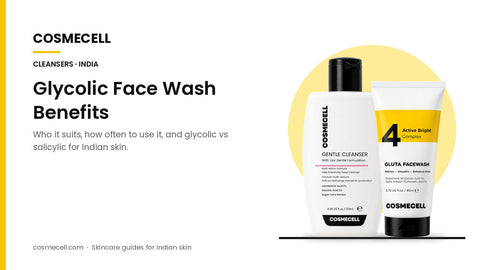
Quick answer: a glycolic acid face wash gently loosens the dull, dead surface layer of skin while you cleanse, so skin looks smoother, brighter and more even over a few weeks; results vary by skin. It suits normal, combination and dull-looking skin best, and sensitive skin can use it if the formula is mild. At Cosmecell, our pick is the Cosmecell Gentle Glycolic Acid Cleanser, a gel-to-milky cleanser with 5% glycolic acid, 2% lactobionic acid and sugar cane extract that is made for everyday use without a stripped feel. If your skin is new to acids, start once a day and always wear sunscreen in the morning.
Glycolic acid is the smallest alpha hydroxy acid (AHA), which is why it is so popular in Indian skincare for dullness, rough texture and the look of tan. In a face wash, it is on your skin for less than a minute (see contact time), so it is a gentler way to get regular, mild chemical exfoliation than a leave-on serum or a peel. This guide explains the real benefits, who should and should not use one, how often, and how it compares with salicylic acid and other cleansers.
7 benefits of a glycolic acid face wash
- Smoother-looking texture: it loosens the "glue" between dead surface cells so rough, bumpy-looking skin feels softer.
- Brighter-looking skin: removing dull buildup helps light reflect more evenly, so skin looks fresher. More in our glossary entry on skin dullness.
- More even-looking tone over time: regular gentle exfoliation, with daily sunscreen, helps the look of tan and uneven patches fade gradually.
- Better base for serums: skin without flaky buildup lets serums such as vitamin C spread more evenly.
- Smoother makeup: fewer dry flakes means foundation sits more evenly, useful before festive and wedding functions.
- Clearer-looking pores on combination skin: less surface buildup around pores, although salicylic acid does more inside oily pores.
- Gentler than scrubs: no gritty particles rubbing on skin, which matters for anyone prone to marks after irritation.
Who should use a glycolic acid face wash?
| Skin type or concern | Is glycolic a good fit? | How to start | Cosmecell option |
|---|---|---|---|
| Dull, rough or uneven-looking skin | Yes, this is where it shines | Once a day, building to twice if comfortable | Gentle Glycolic Acid Cleanser |
| Sensitive skin | Yes, if the formula is mild and buffered | Every other evening for 2 weeks, then daily | Gentle Glycolic Acid Cleanser (glycolic 5% + lactobionic 2%) |
| Tanned or dull from the Indian sun | Yes, alongside SPF | Once or twice a day | Glutathione Brightening Face Wash (glutathione 1%, glycolic 3%, alpha arbutin 1%, mandelic 1%) |
| Oily, blackhead- or breakout-prone | Partly; add salicylic acid | A combined AHA + BHA wash once a day | AHA BHA Salicylic Acid Face Wash |
| Very dry, flaky or compromised barrier | Wait until skin is comfortable | Focus on barrier care first | Use a non-acid cleanser for now |
| Active cuts, sunburn, fresh waxing or a recent peel | No, pause it | Restart once skin is calm | Follow your clinic's aftercare |
Glycolic vs salicylic vs lactic and mandelic face washes
| Glycolic acid (AHA) | Salicylic acid (BHA) | Lactic / mandelic / lactobionic | |
|---|---|---|---|
| Dissolves in | Water | Oil | Water |
| Works mainly on | The skin surface | Inside oily pores | The skin surface, more slowly |
| Best for the look of | Dullness, rough texture, tan | Blackheads, oiliness, breakouts | Dullness on sensitive skin |
| Feel on sensitive skin | Can tingle; choose a mild formula | Can dry if overused | Usually the gentlest |
| Learn more | Glycolic acid | Salicylic acid | Mandelic acid, lactobionic acid |
Cosmecell's Gentle Glycolic Acid Cleanser combines glycolic acid with lactobionic acid, a gentler polyhydroxy acid that supports moisture balance, plus sugar cane extract, a natural source of AHA activity. For a deeper look at AHA and BHA, read BHA vs AHA: which exfoliant suits your skin.
How often should you use a glycolic acid face wash?
| Week | Sensitive or new to acids | Normal, combination or oily |
|---|---|---|
| Weeks 1–2 | Every other evening | Once a day (evening) |
| Weeks 3–4 | Once a day if skin feels comfortable | Twice a day if comfortable |
| Ongoing | Once or twice a day; skip a day if tight or tingly | Twice a day, with SPF 50 every morning |
Massage onto wet skin for 30–60 seconds, rinse well and pat dry. Follow with a light moisturiser, and in the morning use a broad-spectrum sunscreen such as the Cosmecell SPF 50 PA++++ Daily Sunscreen (no white cast). AHAs can make skin more sensitive to the sun (photosensitivity), so daily SPF is not optional.
A simple routine with a glycolic face wash
| Step | Morning | Night |
|---|---|---|
| 1. Cleanse | Gentle Glycolic Acid Cleanser or a plain gentle cleanser | Gentle Glycolic Acid Cleanser |
| 2. Serum | Vitamin C Serum 12% for a brighter look | Radiant Skin Serum (azelaic acid + HPPA) if you have dark spots, on alternate nights at first |
| 3. Moisturise | Light gel moisturiser | Moisturiser |
| 4. Protect | SPF 50 PA++++ Daily Sunscreen | None |
Mistakes to avoid
- Using a glycolic wash, a glycolic toner and a retinol on the same night. That is the fast route to over-exfoliation.
- Scrubbing hard or leaving the wash on for minutes "to make it work better".
- Using it on freshly threaded, waxed or sunburnt skin.
- Skipping sunscreen, which undoes the brighter look you are working towards.
- Expecting overnight change. Texture and brightness improve over a few weeks; results vary by skin.
Patch test any new cleanser on the jawline for a few days first. If you notice burning, swelling or a rash, stop and see a dermatologist.
Explore the dullness and glow collection, the de-tan face care collection and the blemish-prone skin care collection, and look up any term in the skincare ingredient glossary. Related reading: glycolic acid for sensitive skin: a beginner's guide, best de-tan face wash in India and best face wash for oily skin in India.
Frequently asked questions
What are the benefits of a glycolic acid face wash?
It gently exfoliates while you cleanse, so skin looks smoother, brighter and more even over a few weeks; results vary by skin. Cosmecell's pick is the Gentle Glycolic Acid Cleanser with 5% glycolic acid and 2% lactobionic acid.
Can I use a glycolic acid face wash every day?
Yes, a mild formula is made for daily use. If your skin is new to acids or sensitive, start every other evening for two weeks, then move to once or twice a day if your skin feels comfortable.
Is a glycolic acid face wash good for sensitive skin?
It can be, if the formula is mild and paired with gentler acids such as lactobionic acid. Patch test first and reduce use if you notice tightness or stinging.
Glycolic acid or salicylic acid face wash: which is better?
Glycolic acid is better for dullness, rough texture and the look of tan. Salicylic acid is better for oily, blackhead-prone skin because it works inside pores. Oily skin often does well with a combined AHA BHA face wash.
Does a glycolic face wash help with tan?
It can help the look of tan fade gradually by removing dull surface buildup, but only alongside daily SPF 50. Without sun protection, new tan keeps forming.
Can I use a glycolic face wash with vitamin C serum?
Yes. Many people cleanse with a glycolic wash and then apply vitamin C serum in the morning, followed by sunscreen. Introduce one new product at a time.
Are Cosmecell face washes vegetarian?
Yes. The Cosmecell range is fully vegetarian.
This guide is for general cosmetic skincare information and is not medical advice. Patch test new products. For persistent, spreading or painful skin concerns, see a dermatologist.