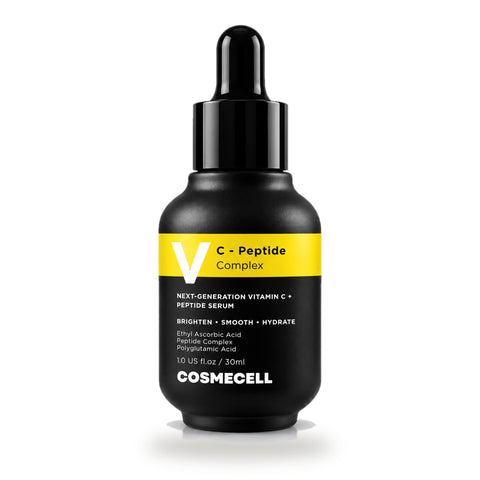
Quick answer: Yes, you can use vitamin C and peptides together, and they suit each other well. Vitamin C helps skin look brighter and more even, and peptides help it look smoother and more supple. Apply the thinner, water-based vitamin C serum first, then the peptide serum, moisturiser and, in the morning, sunscreen. There is one caveat: keep pure L-ascorbic acid and a standalone copper peptide serum in separate routines. To cut a step in humid weather, a 2-in-1 serum such as the Cosmecell VC-Peptide Complex combines both.
This Cosmecell guide covers how the two ingredients work, how to layer them in Indian weather, and the mistakes that cause stinging or pilling. It is cosmetic skincare information, not medical advice.
What each ingredient does
Vitamin C
Vitamin C is an antioxidant. Skin uses it to make collagen, and in skincare it is used to help dull, uneven-looking skin look brighter. A 2017 review in Nutrients notes that pure ascorbic acid is unstable and penetrates skin best at a low pH, below about 4. That is why it can sting and why serums can turn yellow over time (Pullar et al., 2017). Derivatives such as 3-O-ethyl ascorbic acid are designed to be more stable. They are often gentler, though they don't behave exactly like pure vitamin C.
Peptides
Peptides are short chains of amino acids. Cosmetic peptides fall into a few groups:
- Signal peptides, such as palmitoyl tripeptide-1 and palmitoyl tetrapeptide-7, are used for smoother-looking skin and the look of fine lines.
- Carrier peptides, such as copper tripeptide-1 (GHK-Cu), deliver copper to the skin.
- Neurotransmitter-type peptides are marketed for the look of expression lines.
A 2017 review in Cosmetics found encouraging results for several peptides, but noted that many studies are small, some are unpublished, and some tested peptides alongside other actives (Schagen, 2017). Expect gradual, subtle changes rather than dramatic ones.
Why vitamin C and peptides work well together
The two ingredients do different jobs. Vitamin C works mainly on the look of dullness and uneven tone, while peptides work on the look of texture and suppleness. Neither one cancels the other, and both can be used every day. In India's strong sun, vitamin C under sunscreen in the morning is one of the most common skincare pairings. Adding a peptide gives skin a smoother feel without adding another strong active.
The copper peptide caveat
Copper ions can speed up the oxidation of ascorbic acid, and the low pH of pure vitamin C serums is not ideal for copper peptides. For that reason, many formulators suggest keeping pure L-ascorbic acid serums and standalone copper peptide serums in separate routines, with vitamin C in the morning and copper peptides at night. The evidence that this causes problems on skin is limited, but separating them costs nothing.
This applies to mixing two separate serums. A finished formula that already contains copper peptide, such as the Cosmecell SPF 50 PA++++ Daily Sunscreen with Copper Peptide, is stabilised as a whole. Apply it as the last morning step, after your vitamin C serum has absorbed. Signal peptides such as palmitoyl tripeptide-1 do not raise the same concern. To learn more, read copper peptides in skincare.
How to layer vitamin C and peptides
| Step | Morning | Night |
|---|---|---|
| 1. Cleanse | Gentle face wash | Remove sunscreen and dust (double cleanse on heavy days) |
| 2. Vitamin C | Vitamin C serum, 2–3 drops | Optional; skip on retinol or acid nights |
| 3. Peptides | Peptide serum, or skip if using a 2-in-1 | Peptide serum (copper peptide fits here) |
| 4. Moisturise | Light gel in humid cities; richer cream in dry winters | Moisturiser |
| 5. Protect | Broad-spectrum SPF 50, two finger-lengths | None |
Leave about a minute between layers so each one can absorb. This also reduces pilling, the little rolls that form when too many products sit on top of each other, which is common in humid Mumbai or Chennai weather.
Routines for different Indian skin needs
Oily skin in humid weather
Fewer layers work better. Use one 2-in-1 serum such as VC-Peptide (3-O-ethyl ascorbic acid, a palmitoyl tripeptide-1 and tetrapeptide-7 peptide complex, and polyglutamic acid), then a light gel and sunscreen.
Dull, uneven-looking tone
Use the Vitamin C Serum 12% (ascorbic acid with alpha arbutin) in the morning and a peptide serum at night. This keeps the lower-pH vitamin C apart from any copper peptide.
Dry winter skin (Delhi, Pune, Bengaluru)
Put the serum on slightly damp skin, then follow with a richer moisturiser. Polyglutamic acid in a serum helps skin feel hydrated in dry air and AC rooms. For more, read polyglutamic acid vs hyaluronic acid.
Common mistakes
- Layering five serums. More layers mean more pilling and irritation, not better results.
- Using vitamin C, retinol and an acid in one routine. Keep strong actives on separate nights; see peptides vs retinol.
- Skipping sunscreen. Vitamin C works alongside SPF, not instead of it.
- Using an oxidised serum. If a pure vitamin C serum has turned dark orange or brown, replace it.
Frequently asked questions
Can I use vitamin C and peptides at the same time?
Yes. Most vitamin C serums and signal-peptide serums can be used in the same routine. Apply the vitamin C serum first, let it absorb for a minute or two, then the peptide serum, moisturiser and, in the morning, sunscreen. A serum that already contains both, like Cosmecell VC-Peptide, saves a step.
Can I use vitamin C with copper peptides?
Many people do, but the cautious approach is to keep pure L-ascorbic acid and a standalone copper peptide serum in separate routines, such as vitamin C in the morning and copper peptides at night. Copper can speed up the breakdown of ascorbic acid, though the evidence for problems on skin is limited. Finished products that contain copper peptide, such as a sunscreen, can go on after your vitamin C serum has absorbed.
Which comes first, vitamin C or peptides?
Usually vitamin C first, because many vitamin C serums are thin, water-based and work best on clean skin. Then apply the peptide serum, then moisturiser. If your peptide product is a cream, it naturally goes after the serums.
Should I use vitamin C and peptides in the morning or at night?
Vitamin C fits well in the morning under sunscreen. Peptides are gentle enough for morning or night. If you use retinol or exfoliating acids at night, keep vitamin C in the morning and use peptides on the nights you skip strong actives.
Are vitamin C and peptides suitable for sensitive skin?
Peptides are usually well tolerated. Pure ascorbic acid at a low pH can sting sensitive skin, while derivatives such as 3-O-ethyl ascorbic acid are often more comfortable. Patch test on the inner arm or behind the ear for 24 to 48 hours, start once a day, and stop if skin turns red or burns.
Related reading: vitamin C and niacinamide together and vitamin C morning or night.
This guide is for general cosmetic skincare information and is not medical advice. Patch test new products and introduce one at a time. For persistent irritation or skin concerns, see a dermatologist.