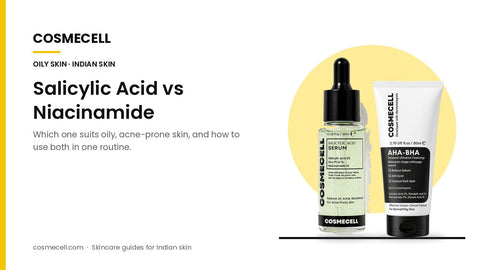
Quick answer: choose salicylic acid if your main concern is clogged pores, blackheads, whiteheads and bumps, because it is an oil-soluble exfoliant that works inside the pore. Choose niacinamide if your main concern is shine, the look of redness, uneven-looking texture or a skin barrier that feels easily upset, because it is a gentle, non-exfoliating vitamin that suits almost every skin type. For oily, humid-weather Indian skin, the two work well together. At Cosmecell, we combine them in the Cosmecell Salicylic Acid Serum 2% (salicylic acid 2% + zinc PCA 1% + niacinamide 1%) and the Cosmecell AHA BHA Salicylic Face Wash (salicylic acid 2% + glycolic acid 3% + mandelic acid 1% + niacinamide 3%).
Salicylic acid and niacinamide are the two most common actives on Indian shelves for oily and acne-prone skin, and they are often sold as competitors. They are not. This guide compares them side by side, matches each to a skin concern, and shows simple ways to use both in a morning and night routine without irritation. For a related comparison, see glycolic acid vs salicylic acid and salicylic vs niacinamide vs zinc for open pores.
Salicylic acid vs niacinamide at a glance
| Salicylic acid (BHA) | Niacinamide (vitamin B3) | |
|---|---|---|
| What it is | A beta hydroxy acid; oil-soluble and keratolytic | A water-soluble form of vitamin B3; not an acid or exfoliant |
| Where it works | Surface and inside pores, through sebum | Surface; supports the skin barrier |
| Best for the look of | Clogged pores, blackheads, whiteheads, bumps | Shine, redness, uneven-looking texture and tone |
| Skin types | Oily, combination, acne-prone | Almost all, including sensitive and dry |
| Feel | Can feel drying if overused | Usually comfortable; rare flushing at high strengths |
| How often | Daily in rinse-off; build up slowly in leave-on | Daily, AM and PM |
| Sun sensitivity | Daily SPF recommended | Daily SPF still recommended |
| Glossary | Salicylic acid | Niacinamide |
What salicylic acid does for oily skin
Because it dissolves in oil, salicylic acid can travel into pores and help loosen the plug of oil and dead skin behind blackheads and whiteheads. Over a few weeks of regular use, pores tend to look clearer and texture smoother; results vary by skin. It suits Mumbai, Chennai and Kolkata humidity, and anyone whose T-zone shines by noon. The trade-off: too much, too often, can leave skin tight or flaky. That is a sign of over-exfoliation, not of it "working harder". More in salicylic acid for blackheads and how to use salicylic acid serum without overdoing it.
What niacinamide does for oily skin
Niacinamide does not exfoliate. It is a skin-conditioning vitamin that helps reduce the look of shine and redness, supports oil control and an even-looking tone, and is easy to pair with almost anything. Because it is gentle, it is often the better first active for sensitive or easily irritated skin. It will not unclog a stubborn blackhead on its own, which is where salicylic acid comes in. See vitamin C and niacinamide together and azelaic acid vs niacinamide.
Which one should you choose? (by concern)
| Your main concern | Start with | Cosmecell option |
|---|---|---|
| Blackheads and whiteheads | Salicylic acid | Salicylic Acid Serum 2% |
| Bumpy texture and clogged pores | Salicylic acid | Salicylic serum, alternate nights at first |
| Oily T-zone and shine | Both | AHA BHA Salicylic Face Wash (salicylic + niacinamide 3%) |
| Look of redness around breakouts | Niacinamide, with gentle salicylic | Salicylic serum (contains niacinamide 1% and zinc PCA 1%) |
| Sensitive, oily skin | Niacinamide first, salicylic in a rinse-off | AHA BHA face wash once a day |
| Marks left after breakouts | Neither alone; add a tone serum | Radiant Skin Serum (azelaic acid + HPPA) + SPF 50 |
Can you use salicylic acid and niacinamide together?
Yes. They are one of the most compatible pairs in skincare, and the old idea that niacinamide must never meet acids is not a practical concern with modern formulas. Three easy ways to combine them:
- One product with both: the simplest option. The Cosmecell Salicylic Acid Serum 2% already includes niacinamide 1% and zinc PCA 1%, plus N-acetyl glucosamine and botanical extracts.
- Split by format: a salicylic face wash (short contact time) and a niacinamide serum or moisturiser after.
- Layering: apply the thinner, water-based salicylic serum first, let it absorb, then the niacinamide product, then moisturiser.
Sample AM/PM routine for oily, acne-prone Indian skin
| Step | Morning | Night |
|---|---|---|
| 1. Cleanse | AHA BHA Salicylic Face Wash | AHA BHA face wash; double cleanse on makeup or heavy-sunscreen days |
| 2. Serum | Salicylic Acid Serum 2%: 2–3 drops (start with nights only if new to acids) | Salicylic serum, or skip on nights skin feels sensitive |
| 3. Moisturise | Light gel moisturiser | Light moisturiser; heavier if skin feels tight |
| 4. Protect | SPF 50 PA++++, two-finger amount; reapply outdoors | Not needed |
Introduce one new product at a time and patch test. Avoid stacking several strong exfoliating products on the same night. If you also use a glycolic product, see the split-routine ideas in glycolic acid vs salicylic acid. For full routines, read oily skin routine for India.
Common mistakes
| Mistake | What happens | Fix |
|---|---|---|
| Using salicylic serum, toner and wash all at once | Tightness, flaking, more shine as skin compensates | One leave-on salicylic product; rinse-off for the rest |
| Expecting niacinamide to clear blackheads | Little change in clogged pores | Add salicylic acid for pores |
| Skipping moisturiser on oily skin | Barrier feels upset; skin can look oilier | Light gel moisturiser daily |
| Skipping sunscreen | Marks after breakouts linger longer | Daily broad-spectrum SPF |
| Mistaking purging for a reaction | Stopping too early, or pushing through irritation | Read about skin purging; stop if it stings or burns |
Explore the blemish-prone skin care collection, the sunscreen collection and the skin barrier collection, and look up any term in the skincare ingredient glossary.
Frequently asked questions
Which is better for oily skin: salicylic acid or niacinamide?
Salicylic acid is better for clogged pores, blackheads and bumps because it is oil-soluble and works inside the pore. Niacinamide is better for the look of shine, redness and uneven texture, and is gentler. Many oily skin types do best with both.
Can I use salicylic acid and niacinamide together?
Yes. They are a compatible pair. The simplest way is one product that contains both, such as the Cosmecell Salicylic Acid Serum 2%, which has salicylic acid 2%, niacinamide 1% and zinc PCA 1%.
Which should I apply first, salicylic acid or niacinamide?
Apply the thinner, water-based product first. Usually that is a salicylic serum, then a niacinamide serum or moisturiser once it has absorbed, then sunscreen in the morning.
Is salicylic acid or niacinamide better for sensitive skin?
Niacinamide is usually the easier first step for sensitive skin. If you want salicylic acid, start with a rinse-off face wash once a day and build up slowly.
Can I use salicylic acid every day?
A salicylic face wash is made for daily use. With a leave-on serum, start on alternate nights and increase only if skin feels comfortable.
Does niacinamide help with acne marks?
Niacinamide can help skin look more even over a few weeks; results vary by skin. For the look of marks, pair it with a tone serum such as azelaic acid and daily sunscreen.
Do I need sunscreen with salicylic acid and niacinamide?
Yes. Use a broad-spectrum sunscreen every morning, such as the Cosmecell SPF 50 PA++++ Daily Sunscreen, which is lightweight, non-greasy and has no white cast.
This guide is for general cosmetic skincare information and is not medical advice. Patch test new products. For persistent, spreading or painful skin concerns, see a dermatologist.