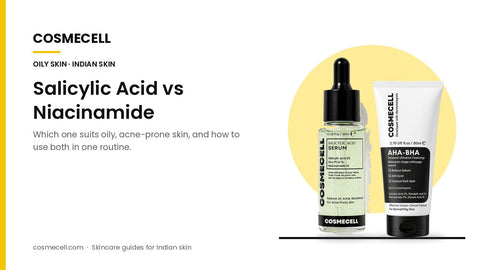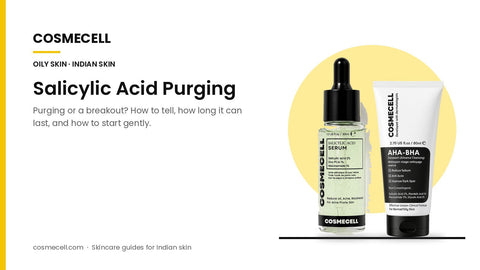
Quick answer: "purging" is the short phase when a new exfoliating active such as salicylic acid speeds up surface cell turnover, so clogged pores that were already forming come to the surface sooner. Purging-style spots usually show up where you normally get them, look like small whiteheads or blackheads, and settle down within a few weeks; results vary by skin. Spots in new places, stinging, burning, itching or rash-like redness are more likely irritation, so reduce use or stop. At Cosmecell, the salicylic products we make are the Cosmecell Salicylic Acid Serum 2% (salicylic acid 2% + zinc PCA 1% + niacinamide 1%) and the Cosmecell AHA BHA Salicylic Face Wash (salicylic acid 2% + glycolic acid 3% + mandelic acid 1% + niacinamide 3%).
Starting a salicylic serum and seeing a few extra bumps can be confusing. This guide explains what skin purging is, how to tell it apart from a breakout or irritation, how long the adjustment phase tends to last, and how to introduce salicylic acid gently in hot, humid Indian weather. New to the ingredient? Start with how to use salicylic acid serum without overdoing it.
What is salicylic acid purging?
Salicylic acid is a oil-soluble BHA. It can travel into pores and is keratolytic, meaning it helps loosen the bonds between dead surface cells. When you start using it, buildup that was already sitting inside pores, such as clogged pores and early comedones, can come to the surface faster than it otherwise would. That brief "everything comes up at once" phase is what people call purging.
The key idea: purging does not create new problems. It brings forward spots that were already on their way. That is why it tends to happen only with ingredients that speed up exfoliation or turnover (salicylic acid, glycolic acid and other AHAs, retinoids), and not with a simple moisturiser or sunscreen.
Purging vs breakout vs irritation: how to tell
| Sign | Purging (adjustment) | Breakout from a product | Irritation |
|---|---|---|---|
| Where it appears | Your usual spot-prone areas (often the T-zone, chin) | New areas where you don't normally break out | Anywhere the product touches |
| What it looks like | Small whiteheads, blackheads or bumps that come and go faster | Spots that linger and keep appearing | Redness, stinging, burning, itching, flaking, rash-like patches |
| Which products cause it | New exfoliating or turnover actives only | Any product (heavy creams, oils, some makeup) | Any product, especially strong acids or too many at once |
| How long it lasts | Settles within a few weeks; results vary by skin | Continues while you keep using the product | Continues or worsens while you keep using it |
| What to do | Keep the routine simple; reduce frequency if needed | Stop the new product and see if skin settles | Stop, rinse, soothe, and see a dermatologist if it persists |
If you are not sure which one you are seeing, reduce the salicylic step to every other day and keep everything else unchanged. If skin feels sore, hot or itchy, stop and ask a dermatologist. See also contact irritation and over-exfoliation in the glossary.
How long does salicylic acid purging last?
There is no fixed timeline, because it depends on your skin, the product, how often you use it and the weather. Many people notice the adjustment phase settle over a few weeks of consistent, gentle use; results vary by skin. If spots are still appearing in new places after that, or are getting worse, it is more likely that the product or the routine does not suit you.
| Phase | What you may notice | What helps |
|---|---|---|
| Starting out | A few extra small bumps in usual areas; skin may feel slightly drier | Use the serum every other evening; moisturise; daily SPF |
| Settling | Spots come and go faster; texture starts to look smoother | Move to daily use only if skin feels comfortable |
| Steady routine | Clearer-looking pores and less visible shine | Keep it consistent; don't add extra exfoliants |
How to start salicylic acid without overdoing it
- Patch test first. Apply a little on the jawline or behind the ear for a couple of days.
- Start slowly. Use the Salicylic Acid Serum 2% every other evening at first, 2–3 drops on clean, dry skin. The product is formulated for AM and PM use, but build up gradually.
- Use one exfoliant at a time. Don't start a salicylic serum, a new acid face wash and a scrub in the same week. If you use the AHA BHA Face Wash as well, consider the serum on alternate nights at first, or try an alternate-night routine.
- Moisturise. A light, non-comedogenic gel or lotion keeps the skin barrier comfortable, even for oily skin.
- Wear sunscreen every morning. Acids can make skin more sensitive to the sun. Finish with a broad-spectrum SPF 50 PA++++ and reapply when outdoors.
- Don't pick. Picking can leave post-blemish marks that last longer than the spot itself.
Salicylic serum vs salicylic face wash: which is more likely to cause purging?
| Format | Contact time | Purging likelihood | Cosmecell option |
|---|---|---|---|
| Leave-on serum | Stays on skin (longer contact time) | More noticeable, especially in the first weeks | Salicylic Acid Serum 2% |
| Rinse-off face wash | Under a minute | Usually milder | AHA BHA Salicylic Face Wash |
If you have sensitive skin or are new to acids, starting with a rinse-off cleanser once a day is a gentler first step. Read more in rinse-off vs leave-on, is salicylic acid face wash safe for daily use? and salicylic acid for blackheads.
Purging and Indian weather
In humid cities, sweat, sebum and heavier sunscreen layers can add to clogged pores, which can make the adjustment phase feel more noticeable. Cleanse after heavy sweating, choose lightweight textures, and use an SPF made for oily or acne-prone skin; see sunscreen for acne-prone skin. In dry winter months, skin may feel tighter on acids, so moisturise well and reduce frequency if needed; see winter skincare routine for India.
When to stop and see a dermatologist
- Burning, stinging or itching that does not settle after rinsing.
- Swelling, rash-like patches or painful, deep bumps.
- Spots spreading to areas where you never break out.
- No improvement, or things getting worse, after a few weeks of gentle use.
Cosmetic skincare can help pores look clearer and texture look smoother. For persistent or painful acne, a dermatologist can advise on what is right for your skin.
Explore the blemish-prone skin care collection and the sunscreen collection, compare acids in salicylic acid vs niacinamide and glycolic acid vs salicylic acid, and look up any term in the skincare ingredient glossary.
Frequently asked questions
Does salicylic acid cause purging?
It can. Salicylic acid speeds up exfoliation inside pores, so clogged pores that were already forming may surface sooner. This adjustment phase usually shows up in your normal spot-prone areas and settles within a few weeks; results vary by skin.
How do I know if it is purging or a breakout?
Purging appears where you usually get spots and clears faster than normal. A breakout from a product shows up in new areas and keeps going. Stinging, burning, itching or rash-like redness is irritation, so stop and rinse.
How long does salicylic acid purging last?
There is no fixed timeline. Many people find it settles over a few weeks of consistent, gentle use; results vary by skin. If spots keep appearing in new places, the product or routine may not suit you.
Should I stop using salicylic acid if I am purging?
Not necessarily. Reduce to every other day, keep the rest of your routine simple, moisturise and wear sunscreen. Stop if you notice burning, itching, swelling or rash-like patches.
Can a salicylic acid face wash cause purging?
It can, but it is usually milder than a leave-on serum because a face wash stays on skin for less than a minute.
How should I start the Cosmecell Salicylic Acid Serum 2%?
Patch test first, then use 2–3 drops of the Cosmecell Salicylic Acid Serum 2% every other evening on clean, dry skin. Move to daily use once skin feels comfortable, moisturise, and use a broad-spectrum SPF every morning.
Is the Cosmecell salicylic range vegetarian?
Yes. The Cosmecell range is fully vegetarian.
This guide is for general cosmetic skincare information and is not medical advice. Patch test new products. For persistent, spreading or painful skin concerns, see a dermatologist.