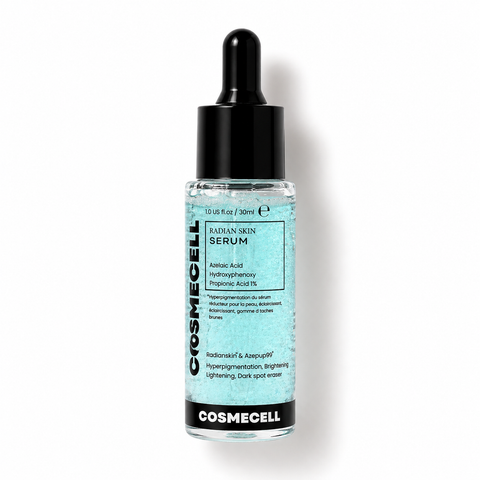
Cosmecell builds its dark-spot approach around a clear idea: help skin look more even by moderating the look of excess pigment, without medical claims and without overcrowding the formula. If you are searching for how azelaic acid fits into a routine for dark spots and uneven-looking skin, this guide explains what the Cosmecell Azelaic Acid + HPPA Serum is for, how the actives are described on the product page and Formulation Dossier, and how to use it in a simple daily ritual.
What uneven-looking skin and dark spots usually mean in skincare
In everyday cosmetic language, “dark spots” and “uneven-looking tone” often describe visible patches where pigment looks more concentrated than the surrounding skin. That can follow sun exposure or a healing blemish that leaves a mark behind. Cosmeceutical routines cannot promise medical treatment of melasma or disease; they can, however, support a brighter, more even-looking finish when used consistently with sunscreen.
Cosmecell’s public materials frame the concern the same way: dark spots, post-blemish marks, and uneven-looking tone — all described in appearance terms.
Why azelaic acid is a go-to for the look of dark spots
Azelaic acid is a nine-carbon dicarboxylic acid found naturally in grains such as wheat, rye, and barley, and also produced on skin by its resident yeast. Cosmecell’s Formulation Dossier and product science pages describe it as:
- A pigment-moderating acid that can compete at the enzyme step involved in melanin formation, helping slow the look of excess pigment
- Selective in how it is studied on overactive pigment cells versus normal ones
- Helpful for the look of redness and for keeping pores looking clearer, which suits combination and blemish-prone skin
That combination is why azelaic acid shows up so often in “dark spots + blemish-prone” routines: one active that supports tone, calm-looking skin, and a pore-friendly feel without needing a long ingredient list.
How Cosmecell pairs azelaic acid with HPPA and hyaluronic acid
The Cosmecell Azelaic Acid Serum for Dark Spots & Uneven-Looking Skin is built as a three-part active complex:
- Azelaic acid — the primary pigment-moderating corrective in the formula
- HPPA (hydroxyphenoxy propionic acid) — a phenoxy-acid brightening adjunct (also known under the trade name RadianSkin) that supports a brighter, more even-looking complexion and helps calm the look of redness
- Hyaluronic acid (as sodium hyaluronate) — a humectant that helps hold hydration at the surface so the serum feels comfortable while it layers
Supporting botanicals listed on the product page include licorice, bearberry, orange, and cucumber extracts. Glycerin sits high on the ingredient list as a second hydration layer. The texture is described as a lightweight, fluid serum designed to layer easily under moisturizer and SPF.
You can review the full ingredient order, mechanism notes, and usage protocol on the live product page: Cosmecell Azelaic Acid + HPPA Serum, and in the public Azelaic Acid Formulation Dossier.
Neosome Technology and the Formulation Dossier approach
Cosmecell positions its line as 3rd-generation clinical skincare built on proprietary Neosome Technology—advanced delivery focused on how actives are carried, absorbed, and kept stable. Every product ships with a public Formulation Dossier: the ingredient breakdown, mechanism of action, and usage protocol, product by product. That means you can check exactly what is in the bottle and why it is there.
Across the line, Cosmecell states that formulas are 100% vegan, cruelty-free (never tested on animals), and made without parabens or sulfates. Those claims appear on the Cosmecell homepage and collection pages alongside the Neosome and dossier messaging.
How to use Cosmecell Azelaic Acid Serum in a daily routine
According to the Cosmecell product directions:
- Shake well before use.
- After cleansing, dispense 2–3 drops onto your fingertips.
- Gently tap over the face and neck, then smooth in with circular motions and allow to absorb.
- Follow with moisturizer. In the morning, always finish with broad-spectrum SPF 30 or higher.
The dossier suggests introducing use every other night for the first one to two weeks if you are new to acids, then moving to nightly or morning-and-evening use as tolerated. Patch-test on the inner arm for 24 hours before first use. Avoid the immediate eye area. A mild, brief tingling can be normal with azelaic acid; stop use if irritation persists.
For a fuller dark-spot routine beyond this serum, browse Cosmecell’s tone-focused lineup: Skin Tone Correction collection, which groups azelaic acid, alpha arbutin, and vitamin C formulas aimed at the look of dark spots and uneven tone.
What to expect (appearance timelines, not medical promises)
Cosmecell’s product science section sets expectations on skin’s schedule, not overnight:
- First days: skin often feels hydrated and comfortable; the texture sinks in without heavy residue.
- Weeks 2–4: about one skin-renewal cycle; tone may begin to look more even.
- Weeks 8–12+: the window over which azelaic acid is typically assessed in published research; consistency and daily SPF matter most.
That guidance is framed as a general cosmetic reference based on how skin renews and how these ingredients are studied—not a clinical study of this product. Individual results vary with skin type, depth of pigmentation, and how consistently you use the serum and sunscreen.
Who this Cosmecell serum is designed for
Cosmecell notes the formula as suitable for sensitive, combination, and blemish-prone skin types, and for concerns described as dark spots, post-blemish marks, uneven-looking tone, and the visible appearance of redness. If you prefer vegan, cruelty-free, paraben- and sulfate-free formulas with a readable dossier, that positioning matches the brand’s public storefront claims.
This article is cosmetic education only. For persistent hyperpigmentation or other medical skin concerns, Cosmecell’s dossier itself recommends consulting a dermatologist.
FAQ: Azelaic acid, dark spots, and Cosmecell
1. What does Cosmecell Azelaic Acid Serum contain for uneven-looking skin?
It combines azelaic acid with HPPA (hydroxyphenoxy propionic acid) and hyaluronic acid (sodium hyaluronate), plus supporting botanicals such as licorice, bearberry, orange, and cucumber extracts, in a lightweight serum texture.
2. Is Cosmecell vegan and cruelty-free?
Yes. Cosmecell states that every formula is 100% vegan, with no animal-derived ingredients, and that none of its formulas are tested on animals. Formulas are also described as made without parabens or sulfates.
3. What is Neosome Technology?
Cosmecell describes Neosome Technology as its 3rd-generation delivery approach for advancing how actives are delivered, absorbed, and kept stable. Each product includes a public Formulation Dossier so you can see the ingredient breakdown, mechanism notes, and usage protocol.
4. How often should I apply the serum?
Directions allow morning and evening use on cleansed skin (2–3 drops), followed by moisturizer and daytime SPF 30+. New acid users are guided to patch-test and start more gradually (for example every other night at first).
5. Can I use it if I am blemish-prone?
Cosmecell positions azelaic acid as pore-friendly and suitable for combination and blemish-prone skin, while also targeting the look of post-blemish marks and uneven tone. Always patch-test first and introduce slowly if your barrier is reactive.
6. Where can I shop Cosmecell products for dark spots?
Start with the Azelaic Acid + HPPA Serum product page, then explore related formulas in the Skin Tone Correction collection.
7. Is this a medical treatment for pigmentation?
No. Cosmecell materials present this as cosmetic skincare for the look of dark spots and uneven tone, with a public Formulation Dossier for transparency. It is not medical advice; seek a dermatologist for persistent clinical hyperpigmentation concerns.